
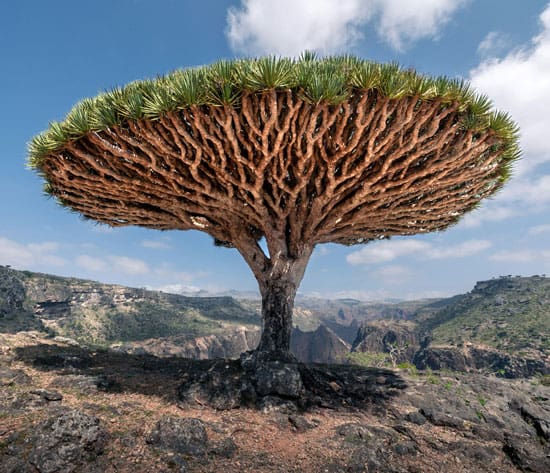
Embark on your adventure on magical Socotra Island to discover its ancient secrets. The Socotra Archipelago is known as a UNESCO World Heritage Site in Yemen, with the most alien-looking out of any found in our world. And the most iconic Dragon Blood Tree, also known as Dracaena Cinnabari, is widely spread across the ground of Socotra. This icon of nature’s creativity is the national tree of Yemen, with the blood-like color resin and a unique umbrella-shaped trunk. And the younger Dracaena Cinnabari looks like a hedgehog.
There are plenty of other natural wonders existing within the ground, which are like Zelda coming to life. Varied terrains turn it into a dreamland for hikers and outdoor sports enthusiasts.
Wandering through and camping amidst the sea of Dragon Blood Trees can be one of the best things to do on a Socotra island tour. Plan and start your expedition on the fascinating island with our practical insights!
Table of Contents
What Is the Socotra Dragon Blood Tree?
Why Is It Called the "Dragon’s Blood" Tree?
Socotra Dragon Tree Facts
How to Visit Dragon Blood Trees
Beyond the Dragon Blood Tree: Other Wonders of Socotra
How to Grow Dragon's Blood Trees in Socotra, Yemen
FAQs about Socotra Dragon Blood Trees
What Is the Socotra Dragon Blood Tree?
Served as the recognizable sign and the national tree of Socotra, Yemen, the Dragon Blood Tree is an evergreen natural habitat, with a unique umbrella-shaped crown to capture the moisture from fog and rain. This long-lived plant can live up to 600 years and grows quite slowly. Its leaves only grow on the youngest branches.
Dragon Blood Tree plays an important role in the mini ecosystem. The umbrella-shaped crown is not only a way to stay hydrated for itself, but also a shield for many plants that cannot survive under the strong sunlight, like ferns and herbs. Besides, it produces the fleshy berries, containing 1 or 4 seeds. These fruits are eaten and scattered by birds, who play a crucial part in the tree’s regeneration.
Nowadays, Dragon’s Blood Trees are seen as a vulnerable species due to climate change and invasive species.
Why Is It Called the "Dragon’s Blood" Tree?
Dragon Blood Trees produce a thick and blood-like sap. When resin flows out of the trunk or is exposed to the air, it looks like bleeding. Therefore, the red sap is also called dragon’s blood. Their saps are usually used as a dye and traditional medicine of Socotra. In addition, some funny folklore and myths tell different stories.
One of the Socotra folklores says that the tree’s name comes from a battle between an elephant and a dragon. During their fierce fighting, their blood spilled on the ground, mingled and soaked into the earth. The places where their blood dripped grew these kinds of strange trees with an unturned umbrella-shaped crown and thick trunk.
Another mythology describes the battle between a dragon and one of the sons of Zeus, Hercules, known as Strongman in ancient Greek myth. He killed the dragon in the battle; after that, the dragon’s blood spilled to the ground and nourished this Socotra dragon tree.
Socotra Dragon Tree Facts
Found only on the Yemen island of Socotra
A living fossil, living up to 600 years
Grow slowly, taking 10-15 years to grow a meter
Dragon Blood Tree sap is used as a dye, traditional medicine, and varnish
Resin used in ancient Roman rituals and Renaissance art
Socotra dragon tree seeds are dispersed by birds and goats (unusual for a desert tree)
An unturned umbrella-shaped crown for reducing evaporation
Blossom until 15 or 20 years old
How to Visit Dragon Blood Trees
Best Time to Visit
The best time to visit Dragon's Blood Trees in Socotra of Yemen belongs to the period from October to April, which is not only the peak season to see Dragon Blood Trees’ full glory, but also suitable for various kinds of outdoor activities.
It embraces the minimal rainfall during these months, and the dry and sunny weather offers the optimal conditions to swim, go sightseeing, and hike to explore the forest. Less rainfall brings a clear sky for you to view the fascinating landscape of the island, and the calmer wind ensures you can more safely dive, canoe, and SUP.
Best Places to See the Trees on Socotra
There are 3 top locations to see the impressive Dragon Blood Trees, including Diksam Plateau, Firmihin Forest, and Homhill Plateau.
Diksam Plateau: Near the centre of the island, Diksam Plateau is home to these impressive trees. Some of them even stand against the cliff. Dirhur Canyon runs through the plateau, offering a perfect backdrop for the photo with dragon blood trees and the Plateau. Also, apart from seeing numerous Socotra dragon trees, people usually camp here to enjoy stargazing.
Firmihin Forest: Step into the Firmihin Forest within Diksam Plateau, another natural habitat of dragon’s blood trees. Here, you will see the largest and continuous forest with the breathtaking Dracaena Cinnabari, the dragon blood trees.
Homhill Plateau: As one of the best scenic spots to see Dracaena Cinnabari views with mountains and coastlines, Homhill Plateau will bring you the extraordinary panorama, especially during sunrise, which is constantly used as the pattern on postcards.
How to Get to Socotra Island
The non-stop flight from Abu Dhabi is the most common and practical way to Socotra Island, but it has been temporarily canceled. But there are still 2 other flights to Socotra available. The first one is the direct flight from Jeddah to Socotra, which only operates once a week. And the flight departing from Cairo on a connecting flight to Aden can be another possible way to reach the destination. Learn more detailed info about flights to Socotra. Feel free to contact us.
Be sure to prepare yourself for the Yemen visa. Arrange your logistics, like transfer, guides, camping arrangements, and accommodation. Or you can choose a private Socotra tour package from Hi Five Trip. We’d love to deal with your tourist visa to Socotra Island and solve some logistics problems. And our professional assistance will save you a lot of hassles.
Essential Tips for Visiting Dragon Blood Tree on Socotra Island
Check the local weather to avoid monsoon climate during the period from June to August. Strong winds and heavy rain during these months are challenging for some outdoor sports.
Pack light and bring breathable clothes, which are essential when you hike and explore the forest.
Wear sun protection, and prepare yourself hat, sunglasses, sunscreen, and mosquito repellent in case of sunny and windy weather.
Hiking is the most common way to explore canyons, mountains, and forests. The terrain of these places tends to be rocky and uneven, so sturdy shoes are indispensable.
Bring enough water to stay hydrated, especially when you hike on the plateaus.
Socotra Island has breathtaking panoramic views, so bring your camera & wide-angle lens. Do not miss the rare chance to capture the magnificence of the landscapes.
Beyond the Dragon Blood Tree: Other Wonders of Socotra
Desert Rose (Adenium Obesum)
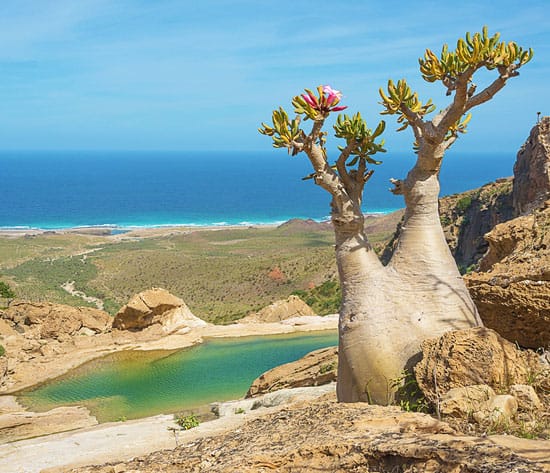
Socotra Desert Rose (also known as Adenium obesum) belongs to a kind of unique native plant in the arid areas of Socotra Island, featuring its thick and bottle-shaped trunk. Its strange shape helps it to store water to survive in the drought and harsh conditions, and is usually regarded as one of the iconic wonders of the island.
Socotra's Unique Landscapes
Except for Dragon Blood Trees, there are plenty of Socotra's unique landscapes. Socotra has diverse terrains, like mountains, limestone plateaus, deep canyons, and beaches, where you can gain various hiking experiences. Distinctive flora and fauna also deserve your visit. Explore more hidden natural gems in this alien-looking land on Earth.
Detwah Lagoon
Situated in Qalansiya, the second largest village on Socotra, Detwah Lagoon is praised as nature’s masterpiece. Characterized by an ideal seascape, it is the place where desert meets ocean, rich in various marine wonders. Detwah Lagoon is one of the best tourist destinations to swim and enjoy a tranquil relaxation from bustling life, offering you an unaffected landscape. Just choose a peak and sit on the top to enjoy the inner peace brought by sunset.
Shoab Beach
Shoab Beach is only accessible by boat from Qalansiya, also known for its white sand and turquoise water. Canoe above the crystal clear water and feast your eyes on the natural beauty. You don’t have to be stuck in the crowds. Here, you will meet with unspoiled cliffs, water, and coastline. If lucky enough, you may encounter a bunch of adorable dolphins when boating.
Arher Beach
As one of the must-sees in Socotra and the most stunning beaches in the world, Arher Beach will definitely not let you down. Featuring the white sand and turquoise water, the beach brings you gorgeous scenery. The combination of sand and water is like two harmonious colors meeting on the natural palette.
Hike up to the top of the Arher sand dunes to catch the sunrise over the ocean and imprint this incredible scene on your memory. The sand of the beach tends to be soft, so it may be challenging to climb. But it definitely deserves your effort!
Homhil Protected Area
Homhil Protected Area is dotted with desert roses and Dragon Blood Tree. And the plateau offers you an ultimate travel experience. Beyond that, it also boasts a natural infinity pool with fresh water, which can be the best place to swim in the refreshing water to cool off while soaking in the spectacular natural landscapes.
How to Grow Dragon's Blood Trees in Socotra, Yemen
Dragon's Blood Trees need a hot and dry climate, and should be nourished by sufficient sunlight. And the temperature between 60°F and 75°F will be more friendly to it. Although it is adept at surviving under dry conditions, the tree still needs some water. If you grow it at home, you can mimic the rain dropping on it, which is close to its original habitat. But remember that it cannot live in an environment with high humidity.
Well-draining sand with a pH of 6.0 or 7.0 favors its growth. The trees need neither too much fertilizer nor pesticide, because they are born to be repellent against insects and mosquitoes. Generally speaking, it will be challenging for them to grow outside of their original home.
FAQs about Socotra Dragon Blood Trees
1. How did the Dragon Blood Tree get its name?
Dragon Blood Tree got its name from its dark red sap, which looks like blood and is known as dragon’s blood resin. There is another myth that says Hercules, a strongman of ancient Greek myth, killed the 100-headed dragon, and its blood created the Socotra dragon tree.
2. Is the Dragon Blood Tree dangerous?
No, the Socotra Dragon Blood Tree does not harm people, and its resin is constantly used to treat some wounds and ailments. But it is dangerous to be swallowed or eaten, especially for children, pets, and people allergic to the plant. Or it may cause bleeding, vomiting, and allergic reactions, as it is rich in saponins. Therefore, you’d better keep them out of reach.
3. Where do Dragon Blood Trees grow?
Dragon's Blood Tree only naturally grows in Socotra Island, an archipelago off the coast of Yemen.
4. Can Dragon Blood Trees grow anywhere?
The Socotra Blood Tree cannot be found anywhere else in the world. Actually, it was originally distributed across the north of Africa and the south of Eurasia. But it only survived in Socotra, as the island maintains a stable environment. And it was gradually distinct in other regions owing to climate change and competition with new species.
5. How does the Dragon's Blood Tree survive?
Dracaena Cinnabari grows in drought areas, which is adept at using its umbrella-shaped canopy to prevent water from evaporating and create a slightly friendly environment for itself.
6. How fast do Dragon Blood Trees grow?
Dragon's Blood Trees of Socotra Island grow extremely slowly, taking about 10 years to reach a meter (3 feet). And they start to branch at about 10 or 15 years old after blossoming.
7. Can I grow a Dragon Blood Tree?
Yes, of course. You can grow the Dragon Blood Tree indoors or outdoors. Sufficient sunlight is the key to the tree. Keep it in the well-draining soil. You do not have to put it in a wet soil mixture, as it is skilled in staying hydrated.
Plan Your Trip to Socotra Island with Hi Five Trip
Plan your unique expedition and embark on your Socotra adventure tours with Hi Five Trip! From vibrant blue water in Qalansiyah Beach to the spectacular Dragon Blood Tree on Diksam Plateau, our escorted tours to Socotra Island will offer you an ultimate travel experience to fully enjoy the unparalleled charm of the island and help you avoid troubles during the trip!
For a more personalized travel to Socotra, feel free to contact us; we’d like to assist you in designing a perfect itinerary.


Have a Question?
You might see your comment appear on this page, but your email address and full name will not be published. Your personal information will remain confidential. Our Asia travel experts will get back to you as soon as possible. Required fields are marked *