
The Temple of Heaven in China is the largest and most well-preserved imperial sacrificial complex, covering an area of 273 hectares, which is 4 times larger than the Forbidden City. The Temple of Heaven in Chinese is called Tiantan. Beijing Tiantan sits in the central area of Beijing City, which was first built in 1420, also the imperial place for emperors of the Ming and Qing Dynasties (1368-1840) to worship at specific times for rain and a good harvest. Not only is the Temple of Heaven in Beijing a part of the most impressive ancient architecture in China, but it is also a cultural treasure as well as one of the First Key Cultural Relics under National Protection.
Table of Contents
Temple of Heaven Facts
Why Visit Temple of Heaven
Temple of Heaven History
What to See in Temple of Heaven
Travel Routes of Temple of Heaven
Temple of Heaven Opening Hours
Temple of Heaven Ticket Price
Best Time to Visit Temple of Heaven
How to Get to Temple of Heaven
Temple of Heaven Travel Tips
Temple of Heaven FAQs
Attractions Nearby
Temple of Heaven Facts
Chinese name: 天坛 (tiān tán) Location: No.1 Tiantan Road, Dongcheng District, Beijing Size: 2,730,000 square meters (about 273 hectares) Opening hours: 6:00-22:00 from April to October; 6:30-22:00 from November to March Entrance ticket: 15 RMB (about 2 USD) from April to October; 10 RMB (about 1. USD) from November to March Time needed: 1.5 hours, depending on travel route and pace Best time to visit: spring & autumn
Why Visit Temple of Heaven
UNESCO World Heritage Site
The Temple of Heaven in Beijing was listed as a World Heritage Site by UNESCO in 1998. After that, it was entitled National AAAAA Classic Scenic Spot in 2007, which is the highest level of tourist attraction in China. It was also a part of the New World Heritage Site, Beijing Central Axis, as one of the masterpieces of the ideal city in ancient China.
Epitome of Sacrifice Culture in Ancient China
Beijing Tiantan was the imperial sacred place for emperors to worship the God of Earth, and also the epitome, which reveals the sacrificial culture in ancient China, and provides a great way to learn ancient ideas of the universe and nature.
Unique Architecture Structure
Temple of Heaven architecture stands out as one of the most representative of ancient architecture. Ancient designers tactfully designed it by applying acoustics, dynamics, and geometry. Its design and layout also reflect the unity of man and nature.
A More Convenient Travel Experience
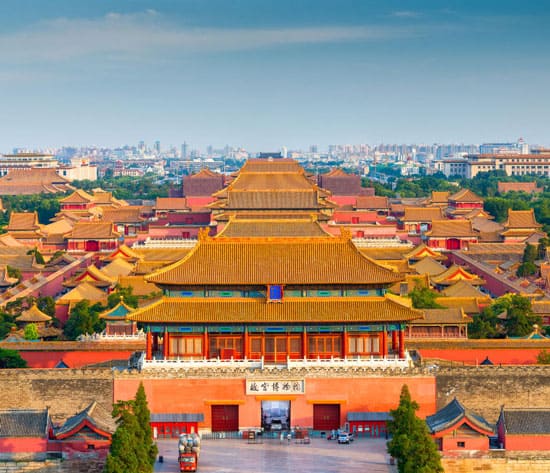
The area of the Temple of Heaven in Beijing is 4 times larger than the Forbidden City. Compared with visitors coming to other hot scenic spots in Beijing, the number of people who visit the Temple of Heaven is relatively lower. Tourists can enjoy a more relaxing environment.
Temple of Heaven History
The Temple of Heaven was constructed during the reign of the Yongle Emperor of the Ming Dynasty (1406 to 1420), who was also responsible for the construction of the Forbidden City. It was originally modeled after the Grand Sacrificial Altar in Nanjing.
In ancient times, Emperors would perform sacrifices in the Circular Mound Altar, when the Winter Solstice was coming, which aimed to worship Heaven for a good harvest. In 1749, the Circular Mound Alter was enlargement during the reign of Emperor Qianlong. In 1752, the Circular Mound Alter and Imperial Vault of Heaven were repaired. The Hall of Prayer for Good Harvest was on fire due to thunder, which was reconstructed in 1890.
The temple complex was badly damaged during the Siege of Beijing by the Eight-Nation Alliance, who took cultural relics and ritual vessels from the temple. During the period, the altar was occupied and served as the force’s central command.
The temple only served as the place for worshiping Heaven in the Winter Solstice without performing any other sacrifice rituals in 1913. In 1918, the Temple of Heaven was officially opened to the public as a park. In 1961, it was declared one of the National Key Cultural Relics Protection Units by the State Council.
What to See in the Temple of Heaven
The Imperial Vault of Heaven
The Imperial Vault of Heaven does not have any horizontal beams to support it, as it is supported by 8 pillars and a spanwork of bars, laths, and brackets. The whole building conforms to the principles of dynamics. And it is also the place, in which the tablets of the Emperor of Heaven and ancestors of the emperors are enshrined.
The Echo Wall
The Echo Wall is a surrounding wall of the Imperial Vault of Heaven and is famous for its acoustics. The wall surface is incredibly smooth and neat, which contributes to the rebound of sound waves.
The Hall of Prayer for Good Harvests
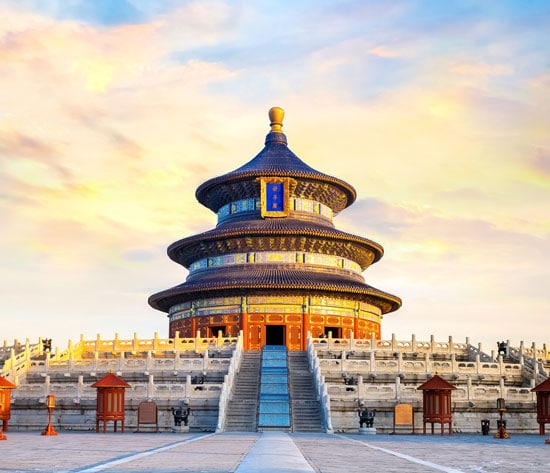
Getting through the Echo Wall and going north, visitors can reach the Hall of Prayer for Good Harvest, which is the main building of the Temple of Heaven and one of the landmarks in Beijing. It is composed of a unique mortise and tenon structure from traditional Chinese architecture, which is extremely solid although without any nails.
The Circular Mound Altar
The Circular Mound Alter was the sacred main space where emperors held the worship ceremony of sacrificing to Heaven on the Winter Solstice. The number of materials used for the altar surface, steps, and railings is all linked to the number 9. That is because 9 is the highest single digit, representing the supreme authority of the emperor.
The Red Throne Steps Bridge
The Red Throne Steps Bridge is 360 meters long, of which in the middle is called Shendao, the passage for divine deities, Yudao in the east and Wangdao in the west. The Bridge is the path from the Imperial Vault of Heaven to the Hall of Prayer for Good Harvest.
Why was the passage called the Bridge? It was said that there is access for livestock under the bridge, which sits on the north side of the Bridge. All poultry for sacrificing must pass through the access before arriving at the pavilion, where they were killed.
Temple of Heaven Layout
The Temple of Heaven shaped with a square is separated into Inner Alter and the Outer Alter by a wall. The square walls in the south represent the Heaven and the circular ones in the north symbolize the Earth, which reflects the philosophical concept of the Round Heaven and the Square Earth.
The Inner Altar is the main area of the temple complex, which is divided into two sides. The Danbi Bridge in the Temple of Heaven connects the Circular Mound Alter and the Hall of Prayer for Good Harvests, forming the north-south axis. The Hall in the north was used to pray for a harvest year in spring, and the altar in the south to honor the heaven in Dongzhi.
Travel Routes of Temple of Heaven
Typically, a visit to Tiantan, the Temple of Heaven, usually begins with the South Gate, the Illustrious Prosperity Gate. Detailed routes are as follows.
Route 1 (3 h): South Gate - Circular Mound Altar - Echo Wall - The Imperial Vault of Heaven - Red Throne Steps Bridge - The Hall of Prayer for Good Harvests
Route 2 (3 h): East Gate - Seven Stars Rocks - Hall of Prayer for Good Harvests - Red Throne Steps Bridge - Echo Wall - Circular Mound Altar - Abstinence Hall - Double Ring Longevity Pavilion
Route 3 (3 h): North Gate - Imperial Strength Hall - The Hall of Prayer for Good Harvests - Red Throne Steps Bridge - Echo Wall - Circular Mound Altar
Temple of Heaven Opening Hours
Opening hours for the Temple of Heaven are as follows:
Opening Hours Peak Season ( April - October ) Off Season ( November- March ) Entrance (East Gate, West Gate, North Gate & South Gate) 6:00 AM-10:00 PM; Stop Entering at 9:00 PM 6:30 AM-10:00 PM; Stop Entering at 9:00 PM Main Attractions (Eaco Wall, Hall of Prayer for Good Harvests, Circular Mound Altar, etc. ) 8:00 AM-6:00 PM; Stop Entering at 5:30 PM 8:00 AM-5:00 PM; Stop Entering at 4:30 PM Recommended Time for a Visit 1.5-2 h
Tip: Tourist attractions above are closed on Monday, except for the public holidays in China.
Temple of Heaven Ticket Price and Guide Service
Temple of Heaven ticket prices are as below:
Ticket Type Peak Season ( April - October ) Off Season ( November- March ) Entrance Ticket 15 RMB 10 RMB Main Attractions (Eaco Wall, Hall of Prayer for Good Harvests & Circular Mound Altar) 20 RMB 20 RMB Combo Ticket (entrance ticket & above attractions) 34 RMB 28 RMB
Guide Service Time Price for Chinese (Mandarin) Price for Other Languages (English, French, Spanish, Russian, Japanese, Korean, etc.) Location Guide Audio 8:15 AM-6:00 PM 30 RMB (No Deposit) 40 RMB (No Deposit) At All Four Gates Team Tour Guide 8:00 AM-3:00 PM 1-5: 200 RMB 6-10: 250 RMB 11-15: 300 RMB 16-20: 350 RMB English: 1-5: 300 RMB 6-10: 350 RMB 11-15: 400 RMB 16-20: 450 RMB At South Gate
Tips:1. The tour guide for the team is paid by hours. 2. Book a tour guide for the team in 2 days ahead, if needed.
Best Time to Visit Temple of Heaven
Spring and autumn are considered the best seasons to visit the Temple of Heaven. To be more specific, it refers to April and October, when they are neither too cold nor too hot in Beijing, especially April to May, which provides a moderate temperature. But this period is just exactly the peak time for traveling. Remember to book tickets in advance, if you’re about to travel there. Better visit the temple park before or around 9 o’clock. The sun may get strong at 11 am.
How to Get to Temple of Heaven
Subway
1. To the East Gate: Take line 5 and get off at Tiantandongmen Station. Then take Exit A and walk for 100 meters
2. To the West Gate: Take line 8 and get off at Tianqiao Station. Then take Exit C and walk for 70 meters
3. To the North Gate: Take line 7 and get off at Qiaowan Station. Then take Exit C and walk for 700 meters
4. To the South Gate: Take line 14 and get off at Jingtai Station. Then take Exit B and walk for 1.2 kilometers, about 20 minutes.
Bus
1. To Tianqiao Station: Take Bus 7, 17, 20, 35, 36, 69, 71, 105, 106, 110, 120, 692, 707, or 729, and get off at Tianqiao Station.
2. To Tiantanbeimen Station: Take Bus 6, 34, 35, 36, 106, 110, 687, or 707, and get off at Tiantanbeimen Station.
3 . To Tiantanximen Station: Take Bus 2, 20, 35, 69, 71, 504, or 826, and get off at Tiantanximen Station.
4. To Tiantannanmen Station: Take Bus 36, 53, 120, 122, 525, 610, or 800, and get off at Tiantannanmen Station.
5 . To Fahuasi Station: Take Bus 6, 25, 34, 35, 36, 39, 41, 43, 60, 116, 525, 610 or 684, and get off at Fahuasi Station.
Temple of Heaven Travel Tips
1 . Recommended Time for Visit: It is recommended to visit the Temple of Heaven for one and a half hours.
2. Things to Take: Bring some water and snacks just in case. Moreover, hats and sunglasses are recommended in summer to protect skin from ultraviolet rays. A pair of comfortable shoes will be more convenient for traveling.
3 . Check for the Route: There are 4 main entrances to The Temple of Heaven, including East Gate, West Gate, North Gate, and South Gate. Most comers will choose East Gate to enter because it is close to the Hall of Prayer for Good Harvests. West Gate is close to the subway station and the Abstinence Hall. Few travelers will visit the Temple of Heaven from the North Gate, although it lies near the Hall of Prayer for Good Harvests. Besides, people seldom travel from north to south. The South Gate sits around the Circular Mound Altar, but far away from the subway station. Get to know which gate you want to go to in advance so that you can visit the Temple of Heaven conveniently.
Temple of Heaven FAQs
1. Why is the Temple of Heaven important?
The Temple of Heaven is the largest and most well-preserved imperial sacrificial complex, and the place for rulers to pray for good harvest, therefore it carries a lot of historical significance.
2. When was the Temple of Heaven built?
Beijing Tiantan was built in 1420, during the Ming Dynasty’s Yongle era.
3 . Why is the Temple of Heaven so famous?
Temple of Heaven is one of UNESCO’s World Heritage Sites, owning over 600 years of history, and attracting numerous visitors.
4. Is the Temple of Heaven in the Forbidden City?
No. They are not in the same place. Although both of them are in the same district, it will take 40 minutes from the Temple of Heaven to the Forbidden City by bus.
5 . What religion is the Temple of Heaven?
The Temple of Heaven in Beijing belongs to Confucianism.
6 . What is the Temple of Heaven used for today?
The Temple of Heaven in China is currently a park where most local people will take morning exercises.
7. Can you go inside the Temple of Heaven?
Yes. The Temple of Heaven allows visitors to enter.
Attractions Nearby
Taoranting Park
Taoranting Park, also known as Joyful Park, is situated in the capital’s Xicheng District, a few blocks away from the Beijing Tiantan. The park covers an area of more than 56 hectares. It is a historic and cultural park, mixed with ancient styles and modern designs. The park mainly highlights Chinese pavilion culture, and there are many other pavilions in the park, of which Taoranting belongs to the most well-known scenic spot. It is one of the Four Famous Pavilions in China and a famous pavilion in the Qing Dynasty (1644-1912).
Beijing Museum of Natural History
Beijing Museum of Natural History is just next to the west gate of the Temple of Heaven, which was opened to the public in 1959. It is the only comprehensive natural museum in China, collecting and exhibiting natural substances with historical, scientific, and artistic values. More than 100,000 natural heritages, including fossils and specimens, are preserved in the museum. In 2023, its name was changed to the National Natural History Museum of China.
Beijing Ancient Architecture Museum
In the same district as Taoranting Park, the Beijing Ancient Architecture Museum is situated in the Temple of Agriculture, between the Temple of Heaven Beijing and Taoranting Park. It is the first Chinese museum that collects, researches, and exhibits Chinese ancient architecture and artifacts, which has been open to the public since 1991. The museum has a variety of exhibitions, like the Hall of the God of the Year, Worshiping Hall, and Side Halls. That represents the history of Chinese ancient architecture.
Plan Your Beijing & China Tour with Us
The Temple of Heaven carries a great value both historically and culturally. Taking a visit to the Temple of Heaven in Beijing, China with a more professional guide can be more enjoyable. Explore more about the Beijing Tour Package, or tailor your trip to other highlighted destinations with our expertise, if interested.

Have a Question?
You might see your comment appear on this page, but your email address and full name will not be published. Your personal information will remain confidential. Our Asia travel experts will get back to you as soon as possible. Required fields are marked *