
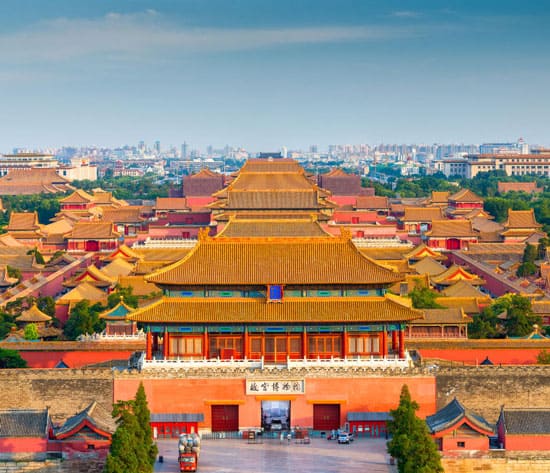
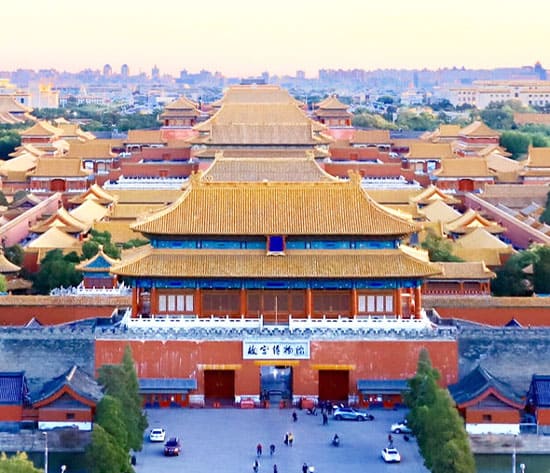
As one of the largest and the most well-preserved palaces in the world, the Forbidden City must be the pre-eminent choice for visitors from both home and abroad. The Forbidden City also known as the Imperial Palace and Palace Museum, ɡù ɡōnɡ (故宫) in Chinese, which located in the heart of Beijing, China. It was the royal place for the Emperors of the Ming and Qing Dynasties (1368-1912 AD) to deal with political business. Not only is the Imperial Palace an unparalleled iconic architectural masterpiece, but it also is a cultural civilization throughout Chinese history. Here are interesting facts about the Forbidden City waiting for your exploration.
1. The Largest Imperial Palace in the World
As the largest imperial palace complex in the world, the Forbidden City covers an area of 725,000 square meters (about 72 hectares), which is equivalent to 163 football fields. Currently, only less than a third of the palace is available for tourists.
It was estimated that about 1 million laborers were involved in the construction. There are over 70 palaces of various sizes. This imperial palace served 24 emperors from the Ming and Qing Dynasties.
As Beijing’s Palace Museum, it is one of the world’s largest cultural museums, open to the public since 1925, and exhibits a series of treasures covering 1.8 million items, 25 categories, and 8,000 first-class artifacts. The Imperial Palace was listed on the World Heritage List by UNESCO in 1987.
2. Why Is It Called the Forbidden City?
One of the must-know Forbidden City Facts is that the Forbidden City is not forbidden anymore. In ancient times, Emperors named themselves the Son of the Heaven, Tianzi in Chinese. Purple shares the same pronunciation as “Zi” and symbolizes royal supreme and majesty in Chinese culture. Therefore, the palace where they lived was also called the Purple Palace, where normal folks were forbidden to enter and only open to the imperial families and officials in the imperial court. Besides, another name is Gugong in Chinese, meaning the Former Palace.
3. Are there 9,999 Rooms in the Forbidden City?
It was said that 9,999 and a half rooms exist in the Beijing Forbidden City. On account of the supremacy of number 9, the highest single digit, it was also considered as the symbol of eternity. Legends say that there are 10,000 rooms in Heaven where the Emperor of Heaven lives. As the Son of Heaven, the number of rooms in the Palace can’t be the same as the Heaven. As a matter of fact, there are precisely 8,707 rooms in the Forbidden City Palace.
4. Are There No Trees in the Forbidden City?
The Forbidden City consists of the political Outer Court and Inner Court for sleeping. Many trees were planted in the Inner Court, but you will find no trees in the Outer Court. There are four main reasons why the Outer Court has no trees.
Firstly, it is a magnificent imperial place to hold some grand ceremonies. A spacious square is suitable for highlighting the supreme of imperial power. Trees would overshadow the majestic atmosphere.
Second, take emperors’ safety into consideration. A variety of ceremonies were held in the palace, where a large number of officials gathered as well. No trees were out of defensive concerns, which meant nowhere for assassins to hide.
Moreover, the construction of ancient imperial palaces was influenced by the Five Elements. In traditional Chinese culture, the outer court for government affairs belongs to Yang, the positive energy, which needs a wide horizon. However, trees are considered as Yin, the negative energy, which is contrary to the layout.
Finally, a wide space without trees is more convenient for holding grand political ceremonies and official gatherings.
5. Imperial Roof Decoration for Imperial Palace Only
One of the fun facts about the Forbidden City is that many animal decorations stand on the roofs of the palace. These animals are also known as the ridge beats, only decorated on the imperial palaces and temples. Their numbers and categories are strictly based on grades and in a particular order. The higher number of roof decorations symbolizes a higher level of architecture. Normal houses were forbidden to be placed.
6. No Chimneys on the Chinese Palace
There are no chimneys in the Forbidden City of Beijing. Most of the architecture in the Forbidden City was wooden building, it was easy to catch a fire. Therefore, people in the Palace mainly relied on braziers and Kang, bed stoves, to avoid fire hazards.
7. No Birds on the Roofs of the Forbidden City
Another fun fact about the roofs of the imperial palace is that the roofs were specifically designed to a particular width so that birds could hardly stay. So, there was barely guano on the roof.
8. Are there Cold Palaces in the Imperial Palace?
The Forbidden City Beijing has no cold palaces. Ancient Chinese concubines and those who made some mistakes or fell out of favor would live in the place, where called the Cold Palace.
9. Millions of Dragons in the Forbidden City
There are millions of dragon designs in Forbidden City architecture. 13,000 dragon designs exist in the Hall of Supreme Harmony, reflecting supreme imperial power.
10. Gold Bricks in the Forbidden City China
It was said that there were many gold bricks in Chinese Gugong. There are bricks indeed, but not made of gold, fired with special processing, which makes them look like gold bricks.
11. A Cauldron Is full of Knife Marks
Why is The Taiping Cylinder in the Hall of Supreme Harmony scarred by knife marks? There are a lot of cauldrons in the Imperial Palace, which was used to store water against fire. However, the Eight-Nation Alliance invaded into the Forbidden City and took all valuables out. At that time, the cauldron was plated with gold. Once found, those soldiers scraped the gold from its surface.
12. 300,000 kg Stone Statues
Stone statues on the Hall of Preserving Harmony weigh a total of over 300 tons, equivalent to more than 40 elephants. An idea about how to transport these statues dawned on the carrying man who dug wells with an interval of 0.5km and sprinkled water on the ground to form a layer of ice so that the statues could be sent through log-rolling.
13. Bronze Lion with Floppy Ears
Generally speaking, the bronzed lion is the symbol of power, but the two lions with floppy ears in the Gate of Heavenly Purity differed from the normal. That’s because the gate near the Inner Court, the harem, and the existence of the two lions were built to warn concubines not to be involved in political affairs.
14. Special Guards in the Forbidden City
Another interesting fact about the Forbidden City in China is that there is a unique patrol team to guard the Imperial Palace. They are actually a band of royal cats. According to the statistics, more than 200 royal cats are living in the palace, and each of them has their own name and gets registration.
Where do they come from? It needs to be dated back to the Ming and Qing Dynasties when it was customary for emperors and concubines to raise cats. Some cats may the descendants of original royal cats, which are regarded as living relics. This guard team patrols around every corner to catch mice and is welcomed by everyone and never driven away.
15. Were All Buildings Decorated with Chinese Architectural Style?
Most of the buildings in the Forbidden City belong to the classical architecture. But there are a few ones with Western style. There is an Arabic-style building named Yude Hall in the northwest of the Wuying Hall, which was a Turkish bathroom built in the Yuan Dynasty (1271-1368 AD). Later, it served for the Emperor of the Ming Dynasty to study, which is unavailable for tourists now.
The other building called Crystal Palace with European style, is located in the Yanxi Palace. The Crystal Palace suffered several fires before, therefore, it was initially designed as a three-layer fire-proof building with two layers of glass outside the wall and a pool at the bottom. However, its construction has never been completed due to various reasons.
Have a Question?
You might see your comment appear on this page, but your email address and full name will not be published. Your personal information will remain confidential. Our Asia travel experts will get back to you as soon as possible. Required fields are marked *