
The Gubeikou Great Wall is situated 146 km (90 miles) southeast of downtown Beijing, which is about a 2-hour drive from Beijing to Gubeikou. It was in a state of disrepair, and not renovated and lengthened in modern times, keeping its original look for a long time. But this authentic appearance still attracts plenty of hiking enthusiasts.
The Great Wall in Gubeikou lies in a rough mountain range. Broadly speaking, it is composed of the Wohushan section, the Panlongshan section, Jinshanling, and Simatai. In a narrow sense, only Wohushan and Panlongshan form the Gubeikou section, viewed as a key fortified pass in ancient times.
Table of Contents
Gubeikou Great Wall Facts
Why Visit Gubeikou Great Wall?
Historical Significance of Gubeikou
Key Features of Gubeikou Great Wall
How to Get to Gubeikou Great Wall from Beijing
Gubeikou Great Wall Travel Essentials & Tips
Top 5 Hiking Trails & Scenic Spots
Nearby Attractions & Tours
FAQs about Gubeikou Great Wall
Gubeikou Great Wall Facts
Chinese name: 古北口(ɡǔ běi kǒu)
Location: Gubeikou Town, Miyun District, Beijing (146 km away from downtown Beijing)
Opening hours: 8:30 am - 4:30 pm
Entrance ticket: 45 RMB
Suggested visit duration: One day
Best time to visit: Spring and autumn
Why Visit Gubeikou Great Wall?
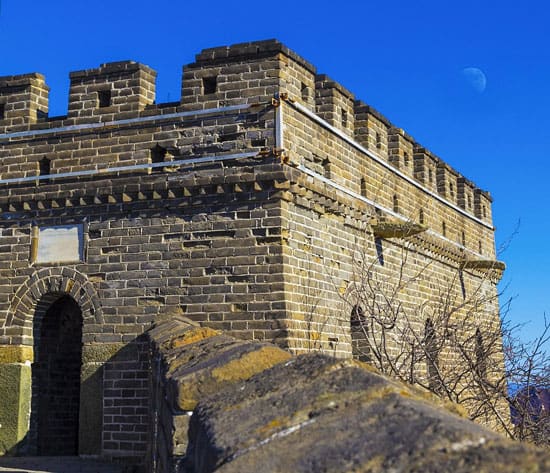
The Gubeikou section of the Great Wall is one of the most iconic wild Great Walls, constructed during the Ming and Qi Dynasties. Only some dangerous parts were restored, and the original appearance remains largely intact. Its authenticity allures history buffs and adventurers to appreciate this man-made masterpiece and feel the raw charm, which still endures after the sun and wind of thousands of years. Gubeikou played a strategic role in Chinese history by protecting Beijing from the invasion of northern nomadic people.
Historical Significance of Gubeikou
A Legacy of Ancient Battles
The Great Wall in Gubeikou was originally built during the Northern Qi Dynasty (556 AD), mainly made of earth and rock. When it came to the Ming Dynasty (1368-1644), the Wall was restored, a few sections of which can be seen today. The most well-preserved part of this section is the Big Flower Tower, which is called Dahualou in Chinese. Later, General Qi Jiguang presided over its renovation, strengthening the wall by adding a new layer based on the original walls. Its last reconstruction and expansion were in 1567.
The Gubeikou section of the Great Wall has witnessed over 130 recorded battles, including defenses against Mongols, Manchu forces, and Japanese forces. This symbol of Chinese resilience has witnessed Chinese history and development.
Architectural Evolution
Different from most of the Great Wall sections we’ve known, Gubeikou employed a unique watchtower design, with various forms of ceilings, like flat, arched, and domed etc. In the early days, the wall was built in a simple structure, and later developed into a complex defense system with diverse forms and functions.
The dual-layer construction could be its most particular feature. The Wall in Northern Qi, based on stone foundations, was later added with Ming brick reinforcements. One of the most iconic buildings is the 24-Eye Tower, with 24 observation windows and a three-layer design. This rare architectural structure still stands there after thousands of years’ experience.
Key Features of Gubeikou Great Wall
Two Distinct Sections
The Gubeikou Great Wall was mainly composed of two sections, the Panlongshan and the Wohushan. Panlong lies in the east, and Wohu in the west.
The Panlongshan section is also known as Coiling Dragon Mountain, where the 24-Eye Tower and the General Tower are located. The iconic 24-Eye Tower was partially preserved, geographically connecting the Jinshanling section through the Longyukou Pass. The Wohushan section is also named as Reclining Tiger Mountain, with the famous Sister Towers, which connect to the Panlongshan section along the Chao River.
Cultural and Military Relics
The Great Wall in Gubeikou stretches over 40 km, consisting of 143 watchtowers, 14 beacon towers, and lots of ancient temples, like Yanglinggong Temple, God of Wealth Temple, and King of Medicine Temple.
The annual fair will be held at the Temple of the King of Medicine, from February 1-10 of the Chinese lunar calendar. A variety of activities on the theme of regime will help you explore the charm of traditional Chinese medicine.
How to Get to Gubeikou Great Wall from Beijing
The Gubeikou Great Wall, situated in Gubeikou Town, Miyun District, is located 146 km northeast of downtown Beijing, taking 2 hours by car. Here are some transportation options for your reference.
By High-Speed Train
Route 1: From Beijing North Railway Station to Gubeikou Wall Railway Station
Trip duration: 2.5 hours
Ticket price: 12 RMB for a single trip
Departure time: 6:57 am; 2:19 pm
Number of departures: 2
Route 2: From Qinghe Railway Station to Gubeikou Wall Railway Station
Trip duration: 2 hours
Ticket price: 12 RMB for a single trip
Departure time: 7:12 am; 2:34 pm
Number of departures: 2
After getting out of Gubeikou Railway Station, walk for 300 meters to the Gubeikou Railway Station Bus Station. Then take Bus Mi25 and get off at the Erzhan Bus Station. Walk 500 meters to reach the scenic spot.
By No. 980 Express Bus
Route 1: From Dongzhimen Junction Bus Station to Suidaokou Bus Station
Trip duration: 3 hours
Ticket price: 27 RMB for a single trip
Departure time:
No. 980 Express: 6:00 am - 8:00 pm
Mi 25: 6:00 am - 5:30 pm
Take No. 980 Express and get off at the Miyun Xinnongcun Station. Then transfer to Mi 25 at the same bus station, and get off at the Suidaokou Station.
Travel with Hi Five Trip
It will be challenging for independent travelers to start a trip, especially for first-timers. Travel with Hi Five Trip, you can enjoy a private China tour for convenience, with a professional tour guide and driver. You do not need to be concerned about a variety of inconveniences, like a language barrier, getting lost, transportation, or some contingencies.
Gubeikou Great Wall Travel Essentials & Tips
Best Times to Visit Gubeikou
Various seasonal beauties exist all year round. The best time to visit the Gubeikou Great Wall is spring and autumn. In April and May, you can savor the lively and warm spring. During the autumn season, from September to October, you will be offered mild weather and vibrant scenery. You should try to avoid paying a visit during the summer and the cold winter to escape the summer heat and sub-zero temperatures.
Entrance Fees & Opening Hours
The admission fee and opening hours of the scenic area have been enumerated for your reference:
Entrance Fee: Opening Hours: 45 RMB 8:30 am - 4:30 pm
Hiking Essentials
1. The Gubeikou belongs to the wild Great Wall, without commercial facilities. Therefore, you’d better bring water and snacks to refuel your strength while climbing.
2. Due to its rugged terrain and your safety concerns, you should avoid hiking in rain or thunderstorms.
3. This section is of moderate difficulty, but with many steep steps and uneven paths. Wear sturdy shoes to protect your ankles, and you can get an easier climb.
4. Layered clothing is essential, especially in the winter season. It will be much colder on the mountain.
Top 5 Hiking Trails & Scenic Spots
Wohushan Section (Reclining Tiger Mountain)
Wild Terrain: The Wohushan Section is in wild terrain, covered with overgrown vegetation and steep steps. The Reclining Tiger Mountain offers an open and magnificent view, allowing hikers to start an adventurous journey.
The Sister Towers: The Sister Towers, situated in the north of Wohushan, are a rare beacon wonder, with a higher beacon and a shorter one. These two adjacent watchtowers look like a pair of hand-holding sisters, whose architectural structure can contain garrisons and hoard some grains and weapons, with a bird's-eye view of the river.
Panlongshan Section (Coiling Dragon Mountain)
The General Tower: At the highest point of the Panlongshan sits the General Tower, which served as the command center in the Ming Dynasty. It is a square building, with symmetrical windows on each side, presenting a typical symmetry. The crenel of the tower was damaged by gunfire during the war, and the round arch was exposed.
The 24-Eye Tower: The 24-Eye Tower is another essence of the Coiling Dragon, featuring 24 observation windows, which is regarded as a less common treasure in the Great Wall of China. The tower sits in a strategic position, composed of three layers, with the same function as the General Tower during the times of war. The tower was partially ruined, but still offers panoramic valley views.
Jinshanling to Simatai West
The Gubeikou section connects to Jinshanling’s restored sections, this route can make you gain a more mixed experience. The Jinshanling Great Wall is connected with Simatai West. If your trip to the Great Wall starts from the Jinshanling section, you can try to hike to Simatai West. But before entering Simatai, you should buy a ticket in advance. After hiking through the General Tower, also called Flower Tower, you will reach the West Tower 15 of Simatai. The difficulty ranges from easy to moderate.
Military Area Detour
It is noted that after climbing over the 24-Eye Tower, there are off-limits zones, set with barbed wire and abandoned barracks. You should make a detour when encountering.
Chao River Valley
The Chao River got its name from its fast-flowing water, which sounds like a tide. It meanders through the Panlongshan and the Wohushan, forming the view of the serene riverside flanking the wall’s base.
Nearby Attractions & Tours
Gubei Water Town
The Gubeikou Water Town, known as Beijing WTown, sits in Gubeikou town as well, at the foot of the Simatai Great Wall section, which is 10 km away from the gate of Gubeikou Great Wall. This town is characterized by mountains, rivers, and ancient buildings. It has the same style as Wuzhen, and that’s the reason why it is seen as “the Wuzhen in Beijing”. Visitors can put this quaint scenic spot on the Great Wall trip list to enrich the journey.
Combine with Jinshanling or Simatai
If you want to maximize your trip, you can hike east from Gubeikou to Jinshanling’s restored section. Next to the Jinshanling stands the Simatai. After hiking in the daytime, you are recommended to appreciate Simatai’s night views. Entering the area before 7:00 pm, you can catch the sunset. After 8:00 pm, the stunning “Night Great Wall” illumination will be presented for you.
FAQs about Gubeikou Great Wall
Is Gubeikou safe for solo travelers?
It is recommended to hike with companions due to its wild terrains.
Can I visit without a guide?
Possible, but guided tours with Hi Five Trip can ensure your safety and enrich historical insights.
Is photography allowed?
Yes. You can freeze the moment of highlight panoramic views from the 24-Eye Tower.
Explore Gubeikou Great Wall with Hi Five Trip
If you are intrigued by further exploring the Great Wall of China or more Beijing highlights, here are some of our best-selling China tours, including the Great Wall of China:
Not fit your needs or not interested in tours above? Feel free to contact us to express your requirements so that our experienced China travel consultant can design a unique trip for you.


Have a Question?
You might see your comment appear on this page, but your email address and full name will not be published. Your personal information will remain confidential. Our Asia travel experts will get back to you as soon as possible. Required fields are marked *